GOES measurements have minimal delay
Aurora Dashboard
announcementApproximately 56 minutes before this data reaches Earth.
26
Power North (GW)
ⓘ
Measures the total energy fueling the aurora in this hemisphere. Higher values mean a stronger, more visible aurora that can be seen closer to the equator (or further from the poles).
-3.2
BZ
ⓘ
The north-south direction of the sun's magnetic field. A negative (southward) Bz is crucial for connecting with Earth's field and boosting aurora activity.
5.2
BT
ⓘ
The overall strength of the sun's magnetic field. A stronger Bt can indicate more energetic solar wind, which can contribute to aurora intensity, especially when Bz is favorable.
456
Wind Speed (km/s)
ⓘ
The speed of particles flowing from the sun. Faster solar wind delivers more energy to Earth's magnetic field, increasing aurora potential.
1.32
Density (p/cm³)
ⓘ
The concentration of particles in the solar wind. Higher density means more particles impacting Earth's magnetic field, which can intensify auroras.
3.0
KP
ⓘ
A global index (0-9) measuring Earth's geomagnetic activity. While historically used, Kp is a less precise indicator for real-time aurora visibility compared to other factors. Higher Kp values *can* suggest stronger disturbances, but it's not the sole or most reliable predictor.
IMF Chart for Bz/Bt
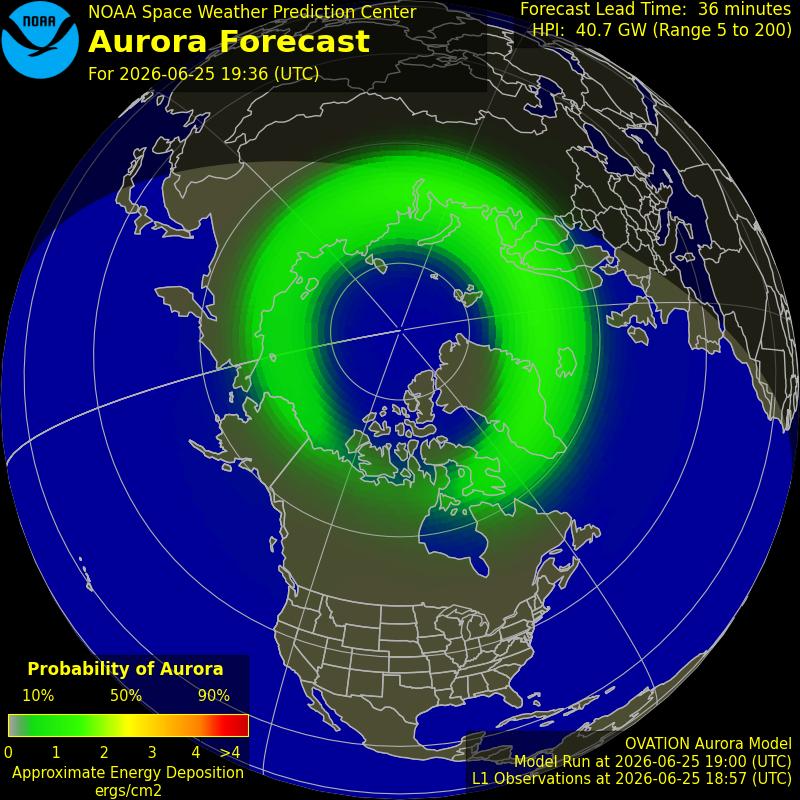
Aurora Oval
Northern Hemisphere